
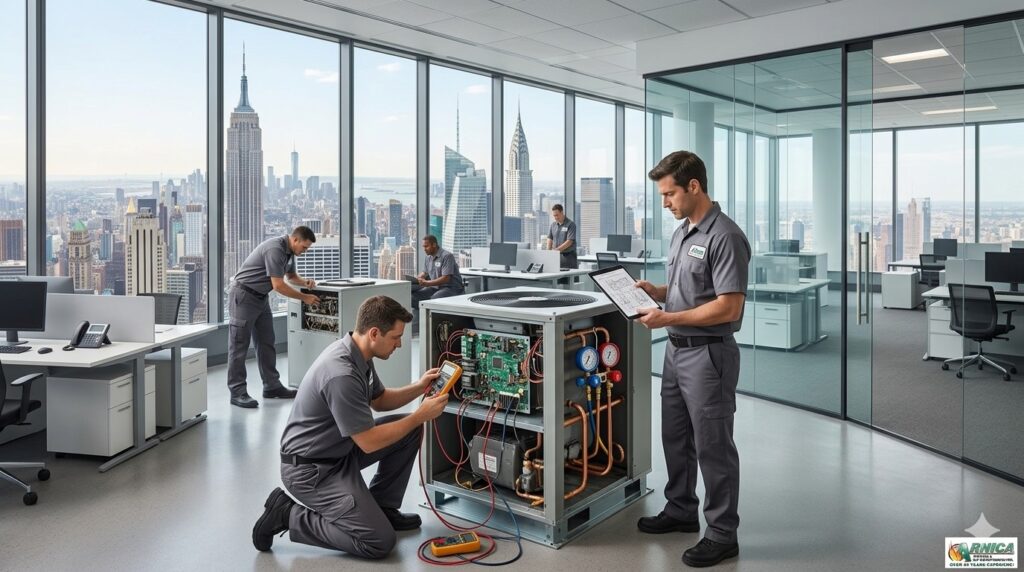
In a place like Manhattan, life at the office never takes a break-and neither do the cooling systems. Central cooling systems in offices are operating by almost all time.
As the years go by and that relentless pressure, that’s when problems begin to appear. In many cases, you might have to call out a couple of times a year for central air conditioning repair in Manhattan.
The answer is straightforward. Excessive use, together with the shortcomings of the city, is putting additional pressure on both of them.
Central Air Conditioning Repairing Service in Manhattan
The Environmental Impact of Urban Heat Islands
The skyline of Manhattan consists of high-rise buildings constructed of metal, glass, and tar, an Urban Heat Island that traps and absorbs an incredible amount of solar radiation. This causes the air around the office buildings to be far hotter long after the sun has set than it would be over other areas.
According to statistics gathered by the New York City Mayor’s Office of Climate and Environmental Justice, New York City is as much as 7 F hotter during the day and up to 22 F hotter during the night relative to the areas around it.
Because of this, the central air conditioning systems in Manhattan offices have to work much longer, fighting both the heat coming through the windows and the heat generated by people within the building, leading to a much faster amount of mechanical fatigue and resulting in frequent repairs.
What Are the Hidden Costs of New York City Air Quality?
While the buildings can maintain internal heat levels, the quality of the outside air in a commercial market such as New York City creates a silent but destructive force that will slowly destroy the useful life of most HVAC systems.
The air in Manhattan has a high level of detectable particulates including bits of soot, construction dust, and other contaminants generated by the constant highway traffic flow.
Based on findings by the New York City Department of Health and Human Services, overall air quality has improved dramatically over the past 10 years, but high traffic high density commercial locations contain the deadliest levels of localized irritants.
These particles settle on the internal coils of the condenser and begin to clog the filtration systems at a rate exponentially above the national average. When this debris coats the coil and the system is then forced to rely on the heat exchange of its internal components, the compressor then has to use high pressure and high temperature settings to compensate for the heat loss, leading to failure of the internal components.
Aging Infrastructure and Modern Cooling Demands
Many of Manhattan’s most elegant workspaces are cloistered within what are known as “pre-war” or early-mid-century high rises, which were not designed for the thermal demands of today’s digital age.
Today’s office is full of hungry, 24/7 server banks, proliferation of individual computer screens spanning every workstation, and high-intensity lighting arrays. Industry numbers are starting to reveal that almost 40% of Manhattan’s commercial office stock predates the 1950 building code.
Often, older architecture was designed with inefficient thermal insulation, breath-blocking ventilation shafts that cause ‘short-cycling,” or rapid-fire on/off electrical capacitors. This electrical ‘stuttering” and mechanical burnout is a primary cause of AC motor failure as the system seeks to chill the 21st century through a 20th century infrastructure.
How Do High Usage Patterns Impact Central Air Conditioning Systems?
Office buildings in Manhattan operate long hours. Some even run 24/7.
That means AC systems rarely get a break.
Instead of cycling on and off like in homes, commercial systems:
- Run continuously throughout the day
- Handle large groups of people
- Adjust frequently due to changing occupancy
Hence, the life of a part is reduced and if not serviced early, small issues can turn into major problems.
Why Does System Overload Happen So Often?
Manhattan buildings are packed—both inside and out.
With so much equipment, lighting and masses of people, heat can be accumulated very quickly. Combine this with aging infrastructure and it’s not unusual for systems to be running well over their optimal loading.
Common overload triggers include:
- High occupant density
- Heat from office equipment
- Poor ventilation in older buildings
- Limited space for modern HVAC upgrades
When systems are pushed beyond their limits, they start breaking down more frequently. No matter how advanced the unit is, overload will eventually catch up.
Are Maintenance Gaps Making Things Worse?
Yes, and this is where many offices fall behind.
Due to busy schedules, maintenance often gets pushed aside. On paper, skipping a check-up may not seem like a big deal—but over time, it adds up.
Missed maintenance can lead to:
- Clogged filters reducing airflow
- Refrigerant leaks going unnoticed
- Worn-out components failing unexpectedly
- Reduced energy efficiency
By the time issues show up, they’re often bigger—and more expensive—to fix.
What Are Practical Solutions to Reduce Repairs?
The good news? Most of these problems are preventable with the right approach.
Start with consistency and planning.
- Schedule routine central air conditioning service
- Upgrade outdated systems when possible
- Monitor system performance regularly
- Address small issues before they grow
Think of it like regular car maintenance. A little effort upfront can save you from major breakdowns later.
What Do People Commonly Ask About Central Air Conditioning Repairs?
Let’s address some common questions seen on Google, as well as found in authentic user discussion.
Why does my office central air conditioning break down so often?
These are the key reasons for its extensive use and high internal heat gains. Systems in commercial environments are just heavily loaded.
How often should central AC be serviced?
At least once every 6 months. Offices with heavy usage may require more frequent inspections.
Is it better to repair or replace the system?
If repairs start to get expensive and happen often, a replacement could be the best long-term solution.
Do small issues really matter?
Of course not, disregarding small glitches does cause big system crashes.
Conclusion
Today’s office buildings in Manhattan have all the elements that contribute to a high incidence of central air conditioning system failures; continuous service, high loads, limited space. As expected, the repair rates are high.
The main is to get in front of the issue. With a maintenance approach and an preventive mentality you will be able to prevent breakdowns.

Over 35 years of experienced HVAC engineer and blogger with years of experience writing about various topics related to multiple types of HVAC systems installation, repair, and maintenance. I have been in this industry since my apprenticeship in 1985. Our team emphasizes quality workmanship while ensuring customer satisfaction is our top priority.


Leave a Reply
You must be logged in to post a comment.