
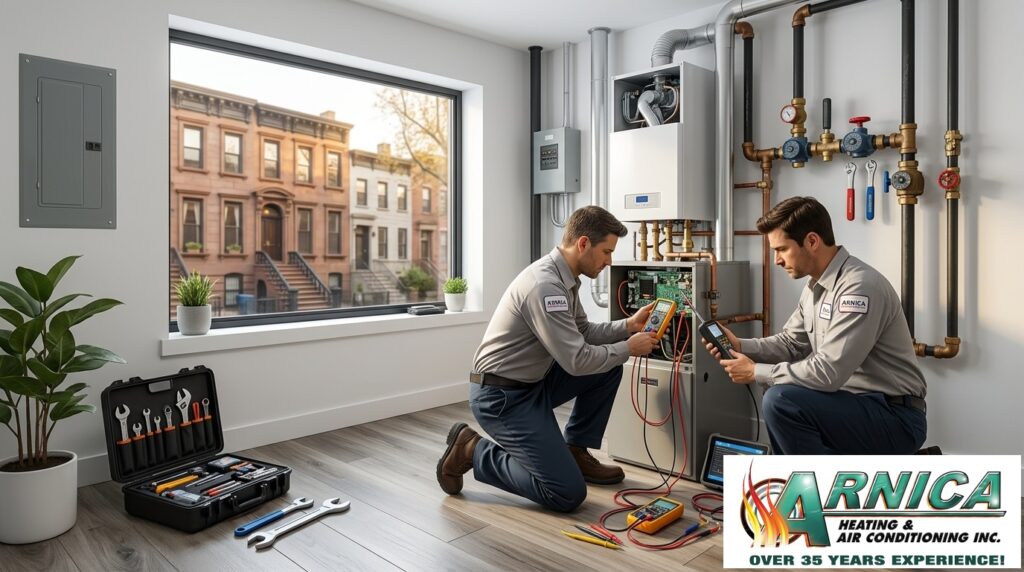
Whenever a New York heating system begins to malfunction, the first thing on everyone’s mind is, ‘How much money is this going to cost to fix?’. The more appropriate question is, ‘What’s the right fix for this building at this moment?’.
That is particularly significant in the older homes in the city. Such a repair makes sense if the equipment still has a lot of life in it. It makes no sense if the equipment has required repairs over the years every winter.
If you are a homeowner or an apartment dweller searching for heating repair in Manhattan or Brooklyn commence with diagnosis and not with the sales pitch.
Diagnose the Symptom Before Choosing the Heating Repair Solution
Irregular rooms, unusual sounds, short cycling, flimsy airflow, stopping every so often and increasing fuel costs do not necessarily indicate replacement.
A technician needs to inspect the equipment, controls, heat distribution, combustion, air flow and building load. With an older New York building, the heat equipment may be relatively efficient even though the building around it has significantly changed.
This is where it becomes intriguing.
When Heating Repair Makes Sense
The repair usually makes sense if the system is built in a good way, reasonably efficient, and the failure is due to a single component.
Many parts of a boiler or furnace, such as the blower motor, ignition part, thermostat, valve or control can be replaced fairly easily while not affecting the rest of the system. An old but well kept boiler or furnace can often last for quite a while yet.
The key is the pattern. One instance of damage is different from recurring damage every winter.
With the technician always having to replace another failed part, the repair history is more useful than any individual invoice.
When Heating Maintenance Isn’t Enough
The mechanics can clean, adjust and tune a system. However, they can’t compensate for the wear over the years.
A boiler with excessive corrosion, a furnace with a ruptured heat exchanger or equipment that has periodically become less efficient may have passed the tune-up stage.
The same applies to the ‘working nearly all the time but still leaving the rooms cold’ systems. The problem is the building load and distribution system should be checked before condemning the plant.
When Heating Replacement or Electrification Should Be Considered
Replacement should be considered if the equipment is aging, requires frequent repairs, safety is an issue or operating costs remain high even though operation is being maintained correctly.
Electrification might also be the best option in the event of a major renovation. Modern heat pumps, which are capable of supplying heating and cooling, have been shown by NYSERDA to have an average coefficient of performance of 3.0 or higher compared to 0.8 to 0.9 for a typical gas furnace.
However, the efficiency on paper above is not all that counts. Building envelope, electrical capacity, equipment sizing and backup heat all count.
How to Compare Long-Term Heating Costs
Never compare systems based on installation cost alone.
Consider:
- Annual fuel or electricity consumption
- Expected repair frequency
- Maintenance requirements
- Equipment lifespan
- Installation and electrical upgrades
- Available incentives
- Comfort and zoning
- Future building regulations
Larger NYC buildings are subject to regulation as well. Local Law 97 is in general targeted at buildings of over 25,000 Square feet, with an obligation to reduce greenhouse gases, with more aggressive mandates arriving later.
Why Older Heating Systems Struggle in Modernized Homes
Renovations and Changed Heating Loads
Renovations have the ability to impact any aspect of the thermal performance of a building.
New windows, insulation, additions, removal of walls or changes to the floor plans. If the building has experienced any of these modifications, it can result in the redistribution and reduction of the heating load.
Insulation vs. Existing Equipment
Enhanced Insulation can significantly reduce heat loss. This is positive, however, it also indicates that the previous heating system size may be over-sized / incorrect.
NYSERDA, in particular, encourages lowering building energy loads prior to electrification as a more efficient envelope can support smaller heat pumps and thus lower the costs of electrification.
Boiler and Furnace Compatibility
A boiler is dependent on its piping, radiators, controls and distribution design; a furnace requires ductwork and airflow.
Focusing on one component in isolation leads to headaches.
Zoning and Modern Controls
Older systems typically heat a large area as a single zone. More sophisticated controls can operate with greater accuracy, but only if the equipment and distribution system are designed to allow this.
When a Heating Assessment Is More Useful Than Another Repair
If the same rooms continue to be uncomfortable after repeated interventions, then stop pursuing individual symptoms.
A whole-system heating assessment can identify whether the issue is equipment capacity, insulation, ductwork, radiator balance, controls or zoning.
Should I Repair or Replace My Heating System?
Repair if the equipment is sound and the fault is specific.
Consider replacing when: problems repeat, performance falls, safety is compromised or the system is no longer suitable for the building.
There is no reason why age should be the sole determinant.
Why Does My Old Heater Need Repairs Every Winter?
Repeated repairs are generally a sign of wear and tear, not misfortune. The older equipment has simply been used more often and so is more likely to have failed.
Another practical point. Frequent mentions of New York residents in discussions on local forums. Buildings that still have owners fixing aging boilers, because replacing them is too hard, costly, or entangled in code and permit issues.
One 2026 discussion mentioned periodic, weekly or biweekly boiler outages for repairs; another user claimed modernizing an aging system would at least triple the cost of a replacement.
Anecdotal evidence, but compelling evidence of how much frustration there is with aging New York infrastructure.
What is causing my old heating system to no longer heat my house effectively?
The equipment may not be the only reason.
Causes include poor venting, poor condition of the insulation, unbalanced radiators, altered room arrangements, broken controls and poor zoning. In a recently renovated house the original installation may just be unsuitable for the building.
The Heating System Became Worse After Renovation. What Changed?
Renovation may also change the heat loss and the heat distribution.
New insulation and windows can reduce the need for heat. Doors removed, can change the air circulation in rooms. Finished basements, extensions and moved walls change the heat distribution.
For example, a discussion local forum about a NY townhouse renovation touches on a homeowner debating whether to retain the old oil boiler and steam radiators or switch to ductless heat pumps, radiant floors, etc. Here, the takeaway isn’t which solution was chosen but that a renovation presents a chance to reconsider a heating approach altogether.
Are Gas Heating Systems Being Banned in New York?
This deserves a nuanced response: it’s not so much that the gas heating systems are banned throughout New York City.
New York City Local Law 154 prohibits the onsite burning of high-emitting fuel sources in specified new construction, with different compliance requirements depending on the type of building and filing date. The law does not require the owner of an existing home to immediately discard a working gas furnace or boiler.
Local Law 97 is another matter. It imposes emissions standards on a significant number of larger buildings, which can make efficiency upgrades and electrification more critical for owners of covered properties.
So, for a retrofit, the smarter question isn’t “Is gas disappearing in the next few years.” It’s “Which heating solution offers the best future-proofed investment, both technically and financially, for this building?”
The Bottom Line
The correct heating answer isn’t always repair; it’s not always replace. Sometimes a tune-up is what is required. Sometimes executing another repair merely delays a foregone capital expenditure. But before you decide anything, calling out experts specializing in heating repair in Brooklyn and Manhattan is essential.

Over 35 years of experienced HVAC engineer and blogger with years of experience writing about various topics related to multiple types of HVAC systems installation, repair, and maintenance. I have been in this industry since my apprenticeship in 1985. Our team emphasizes quality workmanship while ensuring customer satisfaction is our top priority.


Leave a Reply
You must be logged in to post a comment.