
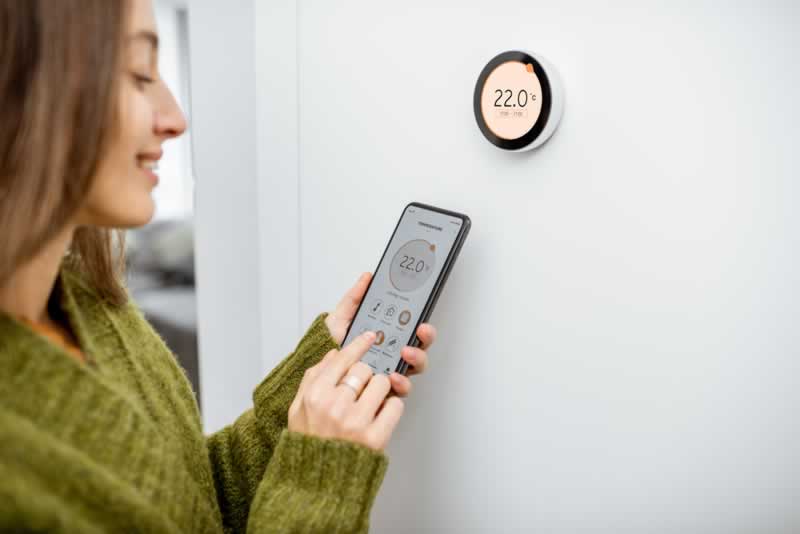
Why Climate Control Using Smart Thermostat is Essential in Modern New York
Energy prices have altered, particularly in New York City. As energy and gas prices rise, homeowners and renters are looking for ways to stay comfortable. Temperature management in older brownstones, townhouses, multi-family homes, and small apartments is increasingly more about cost-effectiveness than comfort.
Older heating systems, insufficient insulation, and shared walls can make a home uncomfortably hot or cold. This is why modern thermostats are now required, rather than optional. Purchasing a thermostat today is similar to choosing a long-term energy plan. So, reach out to experts for heating installation in Queens.
The Unique Heating and Cooling Challenges of New York Properties
Different Climate Issues:
Long, rainy winters in New York necessitate plenty of heating. In the summer, it requires a lot of cooling. Heating consumes a large amount of energy each year, so a decent thermostat is essential.
Apartment Space and Zoning Regulations:
In congested Manhattan and Queens, apartments have central heating or radiators. Residents may be unable to operate the building’s main system, thus they must be able to regulate individual room temperatures.
Comfort is Impacted by High Energy Costs:
Because utility prices are so high, even minor modifications can have a significant impact. Easy-to-use thermostats save energy, maintain temperatures, and prevent unexpected bill rises.
Latest Trends: Categorizing Your Thermostat Options
Thermostats can be set manually
- Benefits: low cost, ease of use, and durability.
- Drawbacks: Savings cannot be automated or optimized.
- Best for: old systems or minimal budgets.
Programmable thermostats
- Benefits: Temperature management is pre-planned.
- Cons: Hand-setup is necessary.
- Best suited for: Consistent schedules.
Smart WiFi thermostats
- Pros: App management, automation, and remote monitoring.
- Cons: Higher starting costs.
- Best for: City workers who travel frequently.
AI-learning thermostats
- Pros: It can create and modify routines.
- Cons: Prices are pricey.
- Best for: Individuals who want to get a lot done quickly.
Zoned smart thermostats
- Pros: You can control the temperature in your room.
- Cons: Setup is challenging.
- Ideal for: multi-story or huge residences.
Initially, manual devices are the most affordable. Smart systems may be more expensive upfront, but they save money over time.
The Smart Advantage: Why New Yorkers Are Upgrading
Smart Scheduling versus Manual Setup
Smart scheduling adapts to you. Manual systems require configuration adjustments.
Precision via Predictive Algorithms
AI thermostats monitor your wake-up, leave-home, and return times. They alter the temperature without your knowing while learning your preferences.
Remote Access for the Urban Commuter
Is Brooklyn-Midtown really that far? Set your phone’s temperature to come home to a warm environment.
Innovative Features of Smart Thermostat
Geofencing Triggers:
Siri or Alexa integration links voice-activated devices to other apps or devices. Users may talk to control smart home appliances, play music, set reminders, and get information. As technology advances, voice assistant integration in automobiles, appliances, and healthcare becomes more prevalent.
Energy Dashboards:
Occupancy detection identifies whether a space is populated. Population numbers can be monitored and assessed using a variety of technologies and methodologies. Knowing how many people are in a space at any given time can aid in resource management, safety, and comfort in buildings and public areas.
Usage Analytics and Reporting:
New Yorkers can expect lower costs and energy savings. In heating-intensive families, smart thermostats can save 10-20% every year. Homes with uneven heating may benefit more from remote sensors.
Return on Investment (ROI):
Most smart thermostats pay for themselves within 12-24 months by cutting utility bills. Heat-intensive buildings benefit more than cool-intensive ones. Choosing the appropriate apartment thermostat might help you save money in the winter.
Critical Buyer Considerations: A Smart Thermostat Guide:
Check these before you buy smart thermostat:
HVAC Compatibility:
refers to how well HVAC systems work together. To ensure peak performance and efficiency, all HVAC system components must be compatible. Compatible systems can communicate, resulting in better temperature control and energy savings. Incompatible components might cause the system to malfunction, waste energy, or fail. So, while installing or upgrading an HVAC system, ensure sure all components are compatible.
Multi-zone Capabilities and Remote Sensor Integration:
Remote sensors gather environmental data. They can track the weather, land use, and ocean. These sensors detect energy reflected or released from Earthly objects. This information is examined by computers. Remote sensors are found on satellites, airplanes, and drones. They help us understand and regulate our planet, making them important in environmental research, agriculture, and urban planning.
User-friendly Mobile App Interface:
Smart home integration is the process of integrating devices and systems in a home to ensure that they operate smoothly. Smart lighting, thermostats, security cameras, and appliances may all be managed through a hub or smartphone app. The goal is to simplify and streamline daily routines so that homeowners have more control over their environment. Customers can use smart home integration to automate routines, remotely monitor their home, and save energy by optimizing gadgets. Overall, it improves life.
Utility Rebate Eligibility and Energy Star Certification:
Energy Star certifies energy-efficient products. A product with the Energy Star accreditation meets stringent U.S. requirements.
Environmental Protection Agency (EPA):
This accreditation applies to appliances, gadgets, and constructions. Energy Star-certified products save money on energy and are better for the environment. The program also encourages entrepreneurs to develop energy-efficient products, which can benefit global health.
AI Learning and Occupancy Sensing:
Occupancy detection identifies whether a space is populated. This could include monitoring and studying population numbers using various technologies. Knowing how many people are in a space at any given time aids resource management, safety, and comfort in buildings. Various systems may use sensors, cameras, or other technologies to monitor occupancy and offer decision data.
The most common mistake that buyers make is failing to confirm compatibility.
New York HVAC Compatibility Guide
Other thermostats may not be compatible with your system.
- Radiators and boilers require low-voltage models or are designed for them.
- Furnaces are compatible with the majority of smart and programmable devices.
- Central air conditioning necessitates multistage support.
- Mini-split systems require brand-specific thermostats.
- Heat pumps require dual-mode thermostats.
- Multifamily systems may require centralized control.
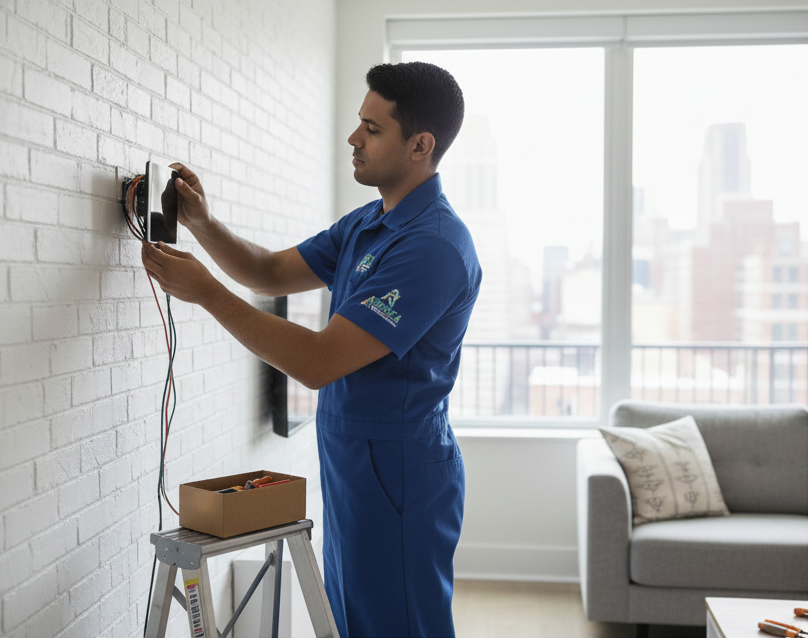
As a result, hiring New York thermostat installers may prove beneficial.
Selecting the Best Device for Your Specific Property Type
The Best Attributes for NYC Apartments:
Wireless sensors collect and transmit data without being connected. Common applications include environmental monitoring, motion tracking, and smart home management. These sensors can communicate and transport data to a central system, allowing for real-time analysis and decision-making. Wireless sensors are more adaptable and convenient, making data collecting easier in settings where wired sensors are difficult to install.
Unwired Installation and Mobile App Control:
App control enables you to manage and use apps on your device. This covers app launch, closure, and setting changes. Apps can be controlled by touch screens, voice commands, or remotes. Good app control guarantees that users can easily access features and enjoy the app.
Brownstones and Historic Renovations:
Brownstones are common in northern American cities. Their name is derived from their brown sandstone architecture. These constructions are three to four stories tall and have a distinct style. Brownstones feature large windows, decorative ornamentation, and a front stoop or stairs. They appeal to both families and individuals because of their spacious rooms and high ceilings. Many nineteenth-century brownstones represent urban existence. Their attractiveness stems from their charm, character, and vibrant communities. Brownstones are still prevalent in Brooklyn, Manhattan, and other locales.
Brownstones can balance heat and have numerous stories due to zoning.
Townhouses and Single-family Homes:
Whole-home zoning improves the efficiency of Staten Island dwellings.
Solutions for Landlords and Property Managers
Fleet monitoring dashboards save money by monitoring several units at once.
Future-Proofing: Next-Gen Thermostat Features
New and developing ideas:
- AI Temperature Prediction
- Smart Integrated Air Vents
- Wire-free room sensors
- Intelligent humidity control
- Grid-responsive thermostats
Utility demand-response integrations manage peak electricity use. When electricity use is high, these campaigns encourage people to cut back. By doing so, utilities can avoid outages and build fewer power plants. Participants may receive lower bills or awards for lowering energy consumption. Overall, these connections boost energy efficiency and reliability. These technologies transform simple thermostats into energy management systems.
Installation Essentials for New York Homeowners
Local considerations affect installation:
- Old electrical Wiring in Pre-World War II Structures
- Compliance with Municipal and State Building Regulations
- Procedures for Obtaining Landlord Approval
- Varying System Voltages
DIY is ideal for simple replacements. Complex boiler configurations should always be performed professional Queens and surrounding heating system installers.
Common Pitfalls: Mistakes to Avoid
- Failing to verify HVAC system compatibility
- Purchasing excessive unneeded features
- Choosing models with poor third-party app support
- Neglecting proper calibration: Calibration ensures that a device or system performs correctly. Without calibration, you risk getting inaccurate results or performance concerns. Calibration guarantees correct measurements and actions. Incorrect calibration can cause problems later, thus it’s critical to follow the instructions.
- Improper positioning near windows or vents
If you install a good thermostat incorrectly, it will operate as poorly as a cheap one.
Proactive Care: Maintenance and Longevity Tips
- Replace batteries annually
- Perform frequent firmware updates
- Recalibrate sensors on an annual basis
- Arrange professional inspections
Proper care can extend their lives by 10 years or more.
Buyer’s Final Checklist: A Decision Framework
- Identify your HVAC system.
- Ensure that the wiring is compatible with the other parts.
- Choose your automation level.
- Check out the energy-saving features.
- Check your rebate eligibility.
- Choose an installation method.
- Consider the app’s ease of use.
To avoid having regrets, follow this procedure when purchasing thermostat models.
What thermostat is best for NYC apartments?
There are no doubt plenty of options. Depending on preference and budget, you may have to choose your option. However, an app-controlled wireless sensor system with no cables makes for a better choice.
Will a smart thermostat save you money?
Yes. Most people can lower their heating bills by 20% per year by incorporating a smart thermostat. Hence, modern heating units feature the same with the goal to reduce energy costs.
Can a thermostat cut heating costs?
Yes, of course. A functional thermostat allows for effective scheduling, which eventually reduces waste.
Which boiler thermostat works best?
Boilers with smart thermostats and low-voltage systems are the options worth considering. The demand for these systems has increased steadily in recent years.
Would you purchase smart thermostats for your apartment?
Yes, particularly where heating costs are high. The best thermostat for apartment allows for energy savings, remote control capabilities via smartphone, and automatic scheduling.
How much does thermostat installation cost in New York?
The cost for thermostat installation in New York varies according to system complexity, ranging from $320 to $750 per unit. Other factors contribute to the cost include labor and materials. Usually, average cost is around $550 for professional service.
Which thermostat is best for New York winters?
Models using remote sensors and learning algorithms are always smart choice. These devices allow users to adjust temperatures from wherever they are. They also help optimize heating by learning your habits and use geofencing to save energy when you are away.
Should I install a smart or programmed thermostat myself?
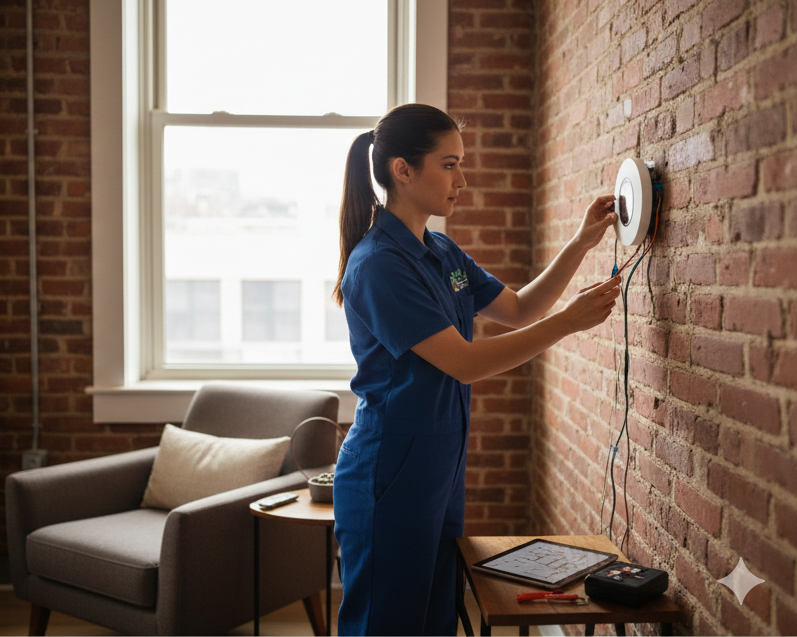
It would be best if you leave it to the experts to install it for you. Self-installation can be problematic in case anything goes amiss or wrong. Yes, there are guidebooks and videos. But, professional installation is a smart way as they know the nitty-gritty of the installation process, saving energy, resource, and money.
Is a WiFi thermostat-enabled apartment safe?
Yes, they are as long as they use strong passwords. These types of thermostats are generally safe and beneficial in terms of energy efficiency, comfort, and in some cases, enhanced safety through early leak or hazard detection.
Are smart thermostats landlord-friendly?
Yes. They are considered quite effective and advantageous for landlords. They offer significant advantages in lowering maintenance and energy costs, preventing HVAC damage.
Choosing the right thermostat in New York, with its harsh weather and high energy bills, is prudent. The right model increases comfort, saves money, and fits your lifestyle. Whether you live in a modest apartment or a multi-story townhouse, making wise investments now will save you money and energy for years.

Simone Arnica is the certified and more than 35 years experienced HVAC expert from Arnica Heating and Air Conditioning Inc. suggesting maintenance tips for the HVAC system to protect it from early damage, unwanted maintenance cost and also to save on energy cost. Follow the blog to learn how it can be done easily.


Leave a Reply
You must be logged in to post a comment.