
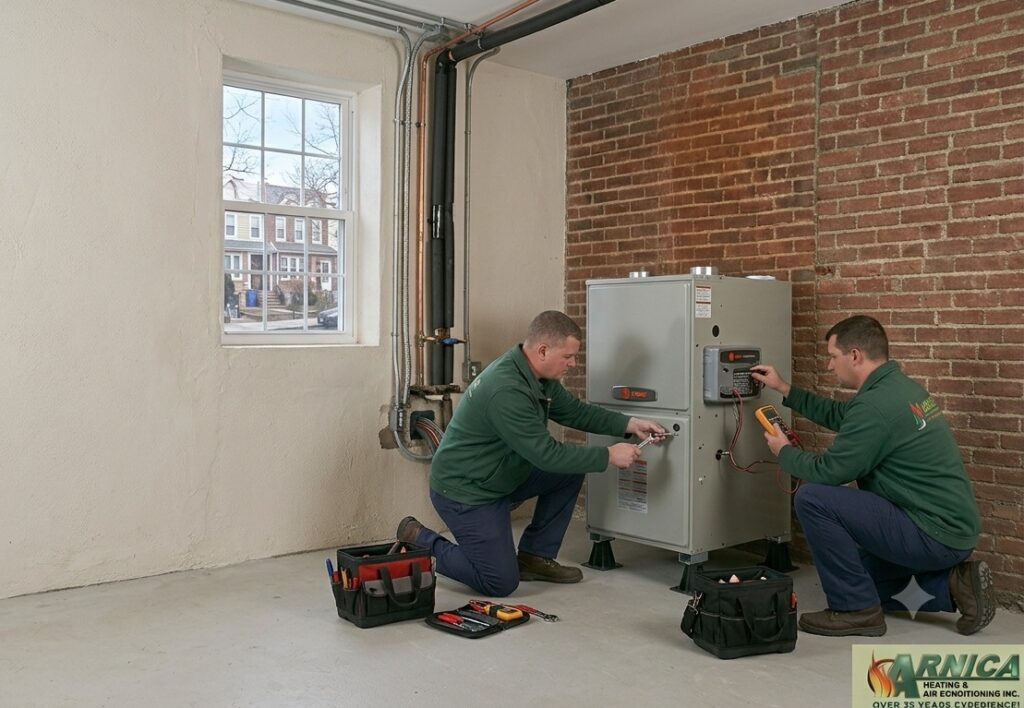
A furnace that starts acting up in January doesn’t care what’s on the calendar. Cold air pushing through the vents, a puddle forming near the exhaust pipe, or a blower that suddenly stops working—any one of these can disrupt your day. A normal Tuesday can quickly turn into a scramble for the phone. Getting the diagnosis right early is what keeps a small hiccup from turning into a bigger, pricier headache. Below are the questions homeowners across Brooklyn, Manhattan, Queens, and Staten Island commonly ask. Many consider these before even calling for furnace repair in New York.
Furnace Repair & Maintenance Service in New York Home
Furnace trouble in New York doesn’t stay quiet for long — not with the kind of winters this city throws around. The EIA’s own numbers show that space heating accounts for over half of total residential energy use in New York homes. When a furnace starts slipping, people notice quickly—often through higher utility bills.
High-efficiency condensing furnaces run impressively lean, somewhere between 90% and 98% AFUE. There’s a catch, though: at peak load, these units can churn out close to a gallon of acidic condensate every single hour. Fine, as long as the drain lines and vent pitch are doing their job correctly. If either one drifts out of alignment, problems start. The moisture doesn’t just sit there. It seeps into floors, walls, and any nearby framing. The damage adds up faster than most people expect.
Every winter, New York sees a predictable wave of emergency heating calls. Thousands of them, spread across the five boroughs, from prewar brownstones to newer builds out in Queens and the Bronx. Local building data highlights something important. Nearly three-quarters of mid-winter breakdowns trace back to maintenance that never happened. This is worth considering. A filter caked with dust, choking off airflow. A safety sensor that’s been degrading quietly for months without anyone noticing.
None of this is really about being overly cautious. It’s about catching small stuff before it turns into a freezing apartment and a 2 AM service call — the kind that costs way more, in every sense, than a routine check-up would’ve.
Why does water keep showing up around my furnace exhaust pipe?
Comes down to what kind of furnace is sitting in the basement.
High-efficiency condensing furnaces are built to squeeze extra heat out of the exhaust gases, and that process creates water as a byproduct — completely normal. It’s supposed to drain away quietly through the condensate system without anyone noticing. When it shows up around the exhaust pipe instead, something’s blocking the flow. A clogged drain, a cracked line, a vent pipe sitting at the wrong slope, or a condensate trap that’s backed up are the usual suspects.
Standard-efficiency furnaces play by different rules. They’re not built to produce water from the vent at all, so any moisture there is worth checking out sooner rather than later.
Is a bit of condensation on the exhaust pipe something to worry about?
Not always.
A little moisture on the PVC vent during a cold snap is pretty normal — that’s just warm exhaust meeting freezing outdoor air. What actually signals trouble is steady dripping, puddles, or staining building up around the vent over time.
So how does a technician fix a leaking vent pipe?
Depends entirely on what’s causing it. A tech might clear out the condensate drain, run new drain tubing, correct the slope on the vent pipe, clear a blockage, or check the vent connections for leaks. Left alone, that kind of moisture chews away at nearby materials and drags furnace performance down along with it.
Why does the flame go out the second the blower kicks on?
Usually points to an airflow problem, or a safety control doing exactly what it’s supposed to do. A dirty air filter choking off airflow, a flame sensor on its way out, a limit switch acting up, pressure switch trouble, burners not firing quite right — any of these can trigger it.
Worth keeping in mind: a furnace’s safety controls are designed to cut gas flow the moment conditions look unsafe. It’s a feature, not a flaw, even when it’s inconvenient at 6am.
Furnace blowing cold air, or the fan won’t even start?
Start with the basics. Check the thermostat settings. Swap out a clogged filter. Confirm that the power hasn’t tripped anywhere. If the fan is dead or only blows cold air, don’t keep restarting the system. That rarely fixes the problem and can sometimes make it worse.
Underneath it all, several things could be causing the problem. It might be the blower motor. It could also be a bad capacitor or the control board. Sometimes, the ignition system is at fault. A safety control might also be tripping for a reason that still needs sorting out.
Is it worth repairing the blower motor on an older furnace?
Sometimes, yeah. If the rest of the unit is in good shape, fixing or replacing the blower motor can extend its life for several more winters. But if something new breaks every season, it’s usually smarter to replace the whole system. This is a better choice for the long run.
What are the real signs a furnace is on its way out?
Replacement becomes worth talking about once a pattern shows up — not after one rough week. Watch for repair calls that keep repeating. Notice if your heating bills go up without a clear reason. Pay attention to rooms that never feel the same temperature. Listen for a furnace that has gotten louder. Look for short cycling or declining reliability. Age alone doesn’t seal the deal on its own, but repeated trouble is worth taking seriously.
What actually gets covered in annual furnace maintenance?
More than a filter swap, that’s for sure. A proper visit covers the burners and ignition components, a cleaned flame sensor, blower operation checked over, safety controls tested, venting inspected, electrical connections verified, airflow measured, and a good look for leaks or wear starting to show. Staying on top of this is what catches the small stuff before it turns into an emergency call in the middle of a cold snap.
Local expertise is what makes the difference
New York homes don’t come in one shape or size. Brownstones, apartment buildings, townhomes, and detached houses are all different. Each one has its own challenges with venting, airflow, and equipment setup. Furnace maintenance in New York needs a local expert. Someone who knows these homes inside and out is better than just using a general checklist.
Arnica Heating and Air Conditioning Inc handles furnace inspections, repairs, maintenance, and replacements. These services are tailored to how New York homes are actually built. Fixing a small problem early keeps the heat steady through winter. It also protects your system for years to come.

Over 35 years of experienced HVAC engineer and blogger with years of experience writing about various topics related to multiple types of HVAC systems installation, repair, and maintenance. I have been in this industry since my apprenticeship in 1985. Our team emphasizes quality workmanship while ensuring customer satisfaction is our top priority.


Leave a Reply
You must be logged in to post a comment.